Recollections: The Bell That Never Rang
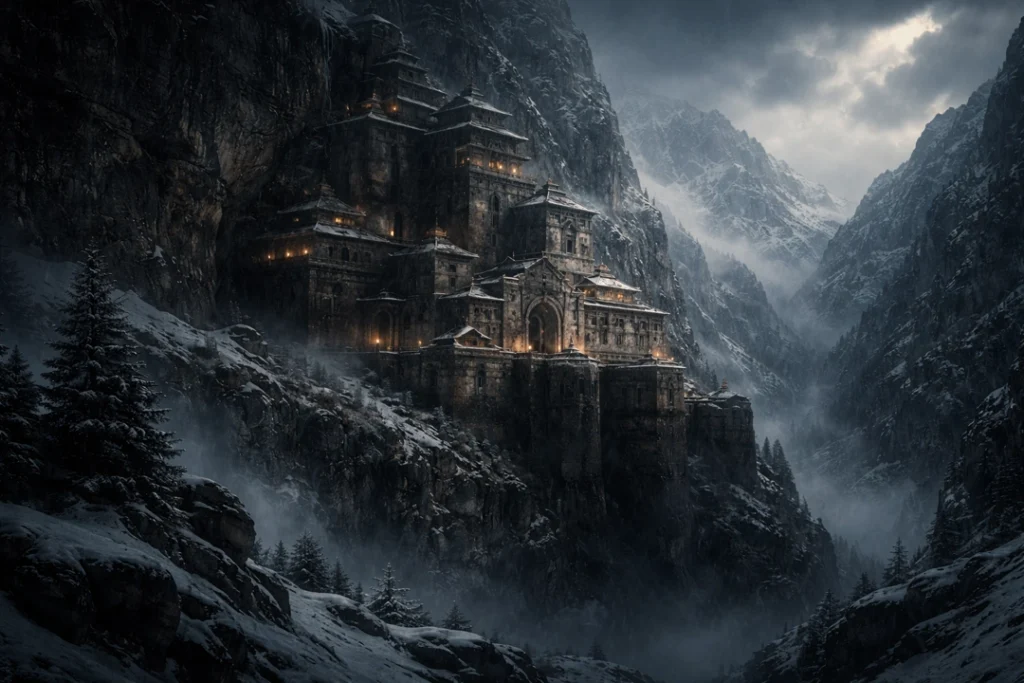
The monastery at The Still Place, hidden deep in the mountains where the bell was never meant to ring.
Some stories begin with maps. Others with whispers.
There’s a sound the wind makes in the highest places on Earth. It isn’t a whistle, and it isn’t a howl. It lives somewhere between the two, low and strained, like the sky itself is trying to remember something it once knew but was never meant to speak aloud. I first heard that sound long before I ever saw the valley they called The Still Place, and even now, years later, I can’t hear wind in the mountains without wondering if something up there is listening back.
This one began with a bottle of rice wine and a man missing half his teeth.
We were in a crumbling inn perched on the edge of the Northern Territories. The kind of place that never appears on modern maps but somehow always has travelers passing through it. The roof sagged in the middle, the windows rattled even when there was no wind, and the fire in the hearth burned with a strange blue flicker that made everyone look like they were already halfway to becoming ghosts.
The man sat across from me, drinking slower than anyone I’ve ever met, like he was afraid the night would notice if his cup emptied too quickly. He spoke in riddles most of the evening, muttering about roads that moved and mountains that forgot their own names. I wasn’t paying much attention until I mentioned I was searching for places no one wrote about anymore.
That’s when he stopped smiling. His eyes sharpened in a way that made the room feel smaller, like the walls had leaned in to listen.
“There’s a bell,” he said quietly. “Hasn’t rung in a thousand years. Not because it can’t…but because it mustn’t.”
He leaned across the table and traced a shape on the table with a cracked fingernail, an eye inside a circle, and said, “You’ll find it in The Still Place. But don’t stay. If you hear the bell, it’s already too late.”
They warned me not to go. They always do.
But this time the warnings weren’t loud or dramatic. No curses, no legends shouted over drinks. Just quiet refusals. A slow shake of the head. Eyes that refused to meet mine. One man dropped his cup when I said the name out loud.
One of them finally muttered, “If the bell rings…the world forgets itself.”
That was enough to convince me it was worth seeing.
I left the next morning with a headache, four fewer coins, and a name I couldn’t stop repeating in my head.
The Still Place.
Getting there took longer than I expected, and every mile made it harder to believe the place actually existed. The flight dropped me in a town that didn’t appear on any chart I could find. A frozen strip of buildings surrounded by mountains that looked too sharp to belong to this world. No one there would say the name I asked for. When I tried to describe the valley instead, the man behind the counter simply turned the sign on the door from OPEN to CLOSED and told me to come back tomorrow.
Tomorrow, he pretended he’d never seen me before.
It took three days to find someone willing to guide me farther north, and even then the woman agreed only after making a small offering to the wind before we left. She tied strips of cloth to a branch outside the town, whispering something I couldn’t understand, then handed me one and told me not to ask what it meant.
We traveled for a week through forests that never seemed to end, snow blowing sideways so hard it erased our tracks as soon as we made them. Twice I woke in the night certain I heard footsteps circling the camp. Slow and deliberate, always stopping when I sat up to listen. The guide claimed the mountains didn’t like strangers and sometimes followed them to see if they deserved to stay.
On the sixth night, I found the symbol carved into the trunk of a dead tree near the fire.
An eye inside a circle.
I didn’t bring it up.
On the eighth day, we crossed a rope bridge that should have collapsed decades ago. The boards frozen stiff and the cables humming in the wind like they were under tension from something I couldn’t see. When I reached the far side, the guide stopped walking.
She pointed ahead, into a valley hidden between two ridgelines.
“That’s as far as anyone goes,” she said.
I went the rest of the way alone.
The Still Place revealed itself slowly, the way old things tend to do. The wind stopped first. Not faded. Stopped. The air felt heavy, like sound itself had been pressed flat. Even my footsteps seemed quieter, swallowed before they could echo.
Then I saw the monastery.
It rose from the mountainside as if it had grown there. Stone carved directly from the cliff face. No road leading to it. No smoke. No movement. Just walls, towers, and a silence so complete it felt like time had been told to wait outside.
They were already standing at the entrance when I arrived.
Dozens of them, wrapped in wool and frost, faces hidden beneath hoods, eyes dull with something that might have been age or might have been warning. None of them spoke. One stepped forward and held up a slab of slate with words scratched into it in a language I somehow understood without knowing how.
Ask nothing. Stay only until the bell stirs.
They let me inside.
The monastery was a maze of corridors lit by oil lamps that flickered like they were running out of centuries. Every wall was covered in carvings. Symbols layered over older symbols. Stories written so many times the stone itself looked tired of remembering them. I saw the eye in the circle more than once, always half-hidden, like whoever carved it hadn’t wanted it noticed.
I found the bell on my first day.
The chamber was larger than I expected. A perfect circle carved deep into the mountain. The ceiling lost somewhere in shadow. In the center hung the bell, suspended by chains as thick as my arm, each link etched with markings worn smooth by time. The chains vanished into darkness above, leaving the bell hanging alone in the middle of the chamber with nothing around it but empty space.
Only when I stepped closer did I realize the center of the room wasn’t floor at all.
The stone path I stood on formed a wide ring along the outer wall, but beyond that the chamber dropped away into a vast circular hollow. The middle of the room falling into darkness so deep my lantern couldn’t find the bottom. The bell hung directly over that void. Far from every wall. Far from any ledge. Completely out of reach from every direction. No ladder. No platform. No bridge. Nothing that could have allowed anyone to stand beneath it.
It was enormous. Bronze, but darker than bronze should be. The surface dull and uneven as if it had been melted and reforged more than once. The air around it felt wrong. Colder the longer I stood there, as if the bell carried its own weather with it. When I tried to lean farther over the edge of the stone ring to get a better look, a strange pressure pushed back at me. Like walking into a wind that wasn’t there.
I circled the chamber twice, following the narrow stone path along the wall, looking for a rope, a hammer, anything that could make the bell ring. There was nothing. No mechanism. No striker. No way to swing it. No way to reach it. The bell didn’t hang in the room like something waiting to be used. It hung there like something placed where no one was ever meant to touch it.
It didn’t look like a bell that had fallen silent. It looked like a bell that had never been meant to ring by force.
As if the only way it could ever sound…was if it chose to.
Near the edge of the stone ring where I stood, a narrow pillar had been carved directly from the rock, waist-high and worn smooth by age. On its surface, cut deep enough that time hadn’t erased them, were words in a language I shouldn’t have known…but somehow understood the moment I saw them.
When the forgotten one remembers, all shall tremble.
I told myself it was just an old warning.
I’ve since learned better.
The nights in the monastery were the worst part. No sound, no voices, just the faint flicker of the lamps and the feeling that the walls were listening. I tried to sleep the second night but woke several times certain someone had been standing beside my bed. Each time I opened my eyes, the room was empty.
On the third night, the storm came.
Snow hammered the stone like something trying to get in. The wind roaring through the towers in long, hollow moans that sounded almost like words if you listened too closely. The monks gathered in the main hall, kneeling in silent prayer. Their heads bowed toward the floor as if they were waiting for something they hoped wouldn’t happen.
I couldn’t sit still. Something kept pulling at the back of my mind. The same feeling I get when I know a story isn’t finished yet. I took a lantern and started walking, tracing the corridors again. Following nothing but the sense that there was more here than they were showing me.
That’s when I found the tapestry. It hung at the end of a narrow passage I didn’t remember seeing before, covered in faded symbols stitched with thread so old it crumbled when I touched it. Behind it, the stone felt warm, like it had been sitting in sunlight even though the monastery hadn’t seen sun in days.
I pushed the fabric aside and studied the wall, tracing the carvings with my fingers. Most were worn down to nothing. But one symbol stood out, cut deeper than the others. An eye inside a circle.
I hesitated for a moment, then pressed the center of the carving.
The stone sank inward with a dull click.
A rumble rolled through the passage, and part of the wall shifted, sliding aside to reveal a narrow opening I would have sworn hadn’t been there before. Inside, a spiral stairway dropped into darkness so deep my lantern barely touched the first few steps. The air that drifted up from below smelled older than the mountain itself.
I should have turned back. Instead, I started down.
The stairs seemed to go on forever. The stone steps worn smooth in the center as if countless feet had passed there long ago. The deeper I went, the quieter the storm became, until the only sound left was the faint crackle of my lantern and the echo of my own breathing.
At the bottom, the passage opened into a cavern larger than the monastery above it. Shelves carved from the rock stretched to the ceiling, filled with scrolls, tablets, and books bound in materials I couldn’t name. The air felt thick, like it hadn’t been disturbed in centuries. I unrolled one scroll and saw a city floating above an ocean, held in the air by ropes tied to clouds. Another showed figures wearing mirrored masks, standing in a circle around a symbol I recognized immediately.
The eye inside the circle.
One parchment made a sound when I touched it. A faint whisper like someone speaking from the other side of a wall. I dropped it without thinking and the echo of the whisper lingered long after it hit the floor.
That’s when I saw the curtain.
It hung across the far wall. Enormous. The fabric brittle but still holding the shape of something that had once been important. I pulled it aside slowly, the lantern shaking in my hand.
Behind it was the mural.
Dozens of figures surrounded a bell identical to the one above. Monks, yes, but others too. Shapes that weren’t quite human, not quite animal. Their eyes painted with a kind of awareness that made my stomach tighten. They stood in a circle, all of them facing inward, as if waiting for something to begin.
And in the center of them stood someone I recognized.
Me.
I laughed out loud, the sound bouncing off the stone in a way that didn’t sound right, like the room didn’t understand what laughter was supposed to be. I stepped closer, raising the lantern to get a better look.
That’s when I heard it. Not loud. Not even clear. Just a vibration, low and deep, felt more than heard, like the air itself had shifted. I turned toward the stair for only a second. When I looked back, the mural had changed. The figure was gone. The bell in the painting was cracked.
I left before morning.
The monks didn’t stop me. They watched from the monastery entrance as I crossed the valley. Their faces hidden. Their hands folded like they were waiting for something they already knew had happened.
I didn’t look back until I was nearly out of the valley. And that’s when I heard it.
One low chime.
Distant. Soft. But real.
The world didn’t end. But something moved. Something old waking up and remembering its name.
That night, miles from the monastery, I found a scrap of parchment in my pack that hadn’t been there before. No writing. Just a crude sketch in brown ink of a figure, hunched, with intelligent eyes. Reminded me of the beings on the mural from the night before. Holding what looked like…a quill.
I never saw one in the monastery. Not directly. But I felt them.
Watching. Listening. Waiting.
I have never returned to The Still Place.
But sometimes I see that symbol again. On the spine of a book I don’t remember buying. In the corner of a painting older than the building it hangs in. Once, carved into the side of a tree that had never been touched by human hands.
And every time, I wonder the same thing.
Was the bell meant for me…or was I the one foolish enough to answer when it finally rang.
The wind still makes that sound in the high places. And I’ve learned to sleep lightly.
And if you think this is the part where I finally explain everything…
You haven’t been paying attention.
More Recollections from The Wink Report
- Recollections: The Vault of the Second Echo
The map led to a circular chamber where sound split in two and the second voice didn’t belong to him anymore. When the vault finally responded, it already knew he was coming. - Recollections: The Typo War (Part I)
Walter Winkwink faces off against a cursed typewriter that attempts to rewrite reality, armed only with a red pen and raw editorial defiance. As autocorrect turns from helpful tool into reality‑warping force, the line between text and truth; and sanity; begins to fray. - Recollections: The Typo War (Parts II & III)
Walter’s battle through the surreal Syntax Spiral continues as the rogue Corrector‑9000 and sentient autocorrect code twist language into war, dragging him deeper into a landscape where grammar becomes battlefield and meaning fights for survival. Here, he confronts the cascading corruption of text and reality itself, armed with red pens, wit, and editorial fury. - Recollections: The Map That Found Me
While wandering through a nameless bookshop in a city that doesn’t exist, Walter Winkwink is given a map that shouldn’t exist—one that changes, disappears, and whispers truths he was never meant to hear. This is the beginning of a journey he wasn’t supposed to take…alone. - Recollections: The Whispering Typewriter
What if your typewriter could predict the future—and then began whispering every twist before it happened? Walter Winkwink is about to find out.
About The Author