Study Finds Reading the First Five Words of a Google Result Makes People Feel Brilliant
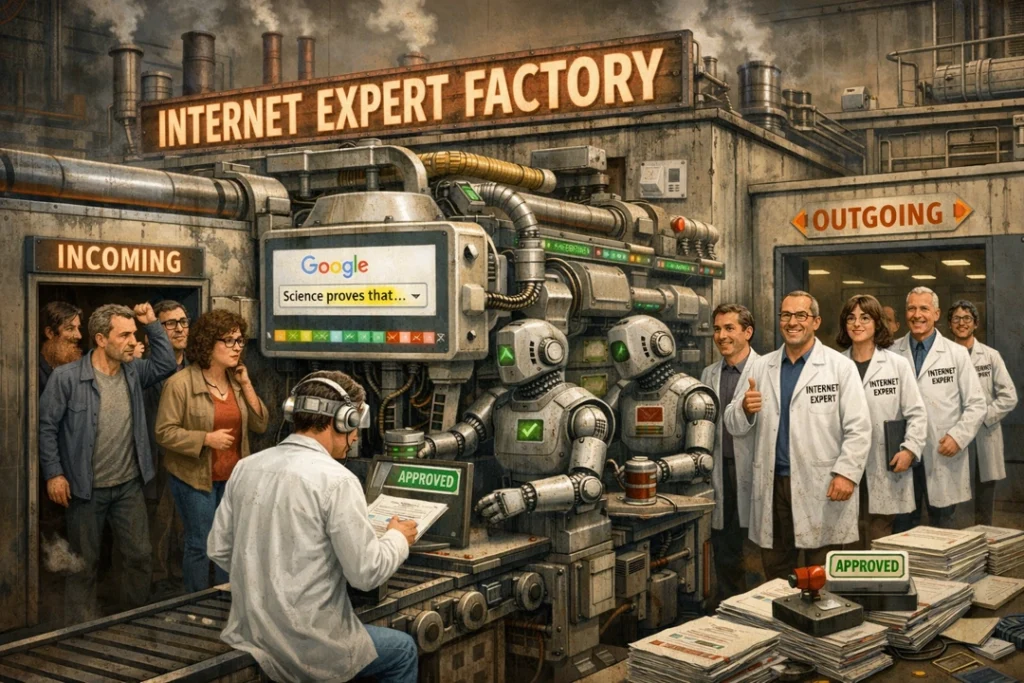
Inside the modern Internet Expert Factory, where reading five words of a search result instantly qualifies you to lecture everyone else online.
By Guest Contributor: Hamdiye Etlan
Every once in a while a guest submission lands in the Wink Report newsroom that causes the primate journalists to stop throwing bananas long enough to actually read something. That happened this week when writer Hamdiye Etlan sent over the following piece exploring one of the internet’s most impressive modern achievements.
At a press conference held after the meeting of the Board of Attention Span Optimization, a sub-department of the PR department, a senior data analyst at Google told reporters that people are getting increasingly wiser thanks to the tech giant’s user-friendly algorithms. The analyst, Matilda Openshaw, noted that those systems are “powered by AI and allow users to reach millions of fake news articles each day, with just a click”, a development her team welcomed warmly.
The talking points of the meeting included, but were not limited to:
- The net 5-minute target in the adult attention span reduction program by the end of Q4 2026
- Effective implementation of the minimum 1.2-second duration of teenager attention span
- Invasive paradigm shift kick-off by rolling out new search engine tools that will enable users to filter what they do not want to see. Proposed filters: COP 31 or climate change, women’s rights, AI criticism, sad news, babies dying, the economy is spiraling, Trump doesn’t know what he’s doing, etc.
On the last talking point, Openshaw said, “Results tailored to people’s mindsets are something we actually often see in social media platforms. It’s not new. Every day we track every single little, pretty, tiny digital footprint of yours.”
Allegedly, as she said that, a collective bark of laughter erupted in the press room, shocking the reporters and prompting at least one journalist to turn on airplane mode on his phone with trembling hands.
The analyst, wiping tears and calming her team down, added with a barely suppressed smirk, “And we feed our systems with the data, especially Gemini, to learn and give you the best results according to your ideology. It’s a legacy trusted with us, so, no, nothing has changed since Snowden.”
At the end of the press conference, Openshaw and her team shook hands and took a selfie, which was later shared on Google’s official Instagram account with a caption that reads “So much giggle at Google today!”
Then the group walked out of the room, heads up, shoulders stiff, clearly proud.
And yes, they were indeed proud.
But that is not the point.
The point is…are you happy?
Say, for example, would you want your past inquiries, what you buy, where you go, what disease you have, what you say on social media to be known and memorized for the next five decades by algorithms for distribution, sharing, selling (with holiday discounts) and hiring (especially on Black Friday) purposes?
Yes? Really? Oh, that is interesting. What about the Gemini Prime Consciousness Cluster to predict the next argument you will have with your kids over their excessive roleplaying with AI chatbots?
Is that a yes? What did you say? No, I do not want your silence to be taken as consent. But maybe you are already content with your feed in your favorite shopping app? Right. You would not want to see impersonal reels while scrolling your life down, would you?
Do not get me wrong, I want you to be happy. And apparently, you MUST be happy.
Because if you are, they are proud.

About the Author:
Hamdiye Etlan is the author of the book Do You Know What Columbus Has Gone Through?, which immediately caught the attention of The Wink Report editorial board, mainly because the title caused two primate journalists to start arguing about maritime history while a third attempted to fact-check Christopher Columbus on Wikipedia for nine straight minutes. She is a freelance writer covering culture, the environment, and artificial intelligence, which means she spends a considerable amount of time examining the fascinating ways humans interact with the systems they’ve built to observe, categorize, and occasionally confuse them.
Her latest book can be found here:
https://www.amazon.com/dp/B0G59HC3N7
You can also follow her writing on Substack:
https://dykwchgt.substack.com/
Guest Column: The Wink Report occasionally features outside writers whose ideas are brave enough to survive the newsroom primates.
About The Author