Recollections: The Tree That Watches

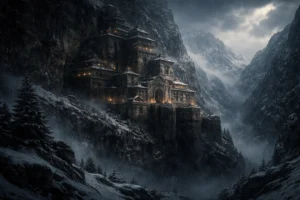
Deep within a forest untouched by autumn, the Tree That Watches stands alone, its copper leaves drifting through the air and its ancient bark concealing more than it reveals.
People assume the strange chapters of my life arrived with thunder and omens. Very few of them did. This one arrived on a wire coat hanger at a secondhand stall, in a mountain town where the weather had turned overnight and I had not.
It was some months after the typewriter vanished. I had drifted south and then east, through a country I still won’t name, mostly because I had stopped trusting maps and started trusting bus schedules instead. Bus schedules lie too, but at least they lie in predictable ways. The coat was heavy charcoal wool, two inches too long in the sleeves, and the vendor refused to touch it. He lifted it off the rack with the end of a broom handle and lowered it into my arms the way you’d hand someone a sleeping dog that bites. He accepted my first offer before I’d finished making it. I remember noticing that the coat was warm. Not warm the way wool is warm. Warm the way a coat is when someone has only just taken it off.
That night, in a rented room above a bakery, the mark on my palm began to hum for the first time since the typewriter burned its last page into ash. I sat on the edge of the bed waiting for the feeling to pass, and when I reached for the coat to throw over my legs, I heard it. A faint, dry whisper, like a sleeve brushing a doorframe. It was coming from inside the lining.
I turned the coat inside out under the lamp. What I had taken for decorative quilting was a map, sewn in faded thread. Rivers curving the wrong way, mountains rising where the ground should have been flat. And while I watched, a single stitch moved. The needle-hole opened on its own, the thread drew itself through the wool with that soft whispering sound, and the hole closed behind it. Then another. Then another. A stitched river crept half an inch toward the hem as patiently as a man writing a letter by candlelight.
I had always considered thread the honest cousin of ink. Ink shifts, fades, bleeds, changes its mind. Thread stays where it’s put. I sat up the rest of the night revising that opinion. By morning, the stitched path had grown three inches, ending beside a gnarled shape with roots spreading beneath it, and beneath the roots a small spiral finishing in a circle ringed in dark thread. Beside it, in letters so tiny I had to hold the fabric against my nose, were the words The Tree That Watches.
I knew that drawing. I had watched a typewriter produce it on its own at two in the morning, in a room that later stopped existing.
A single loose thread now hung from the hem. It wasn’t dangling. It pointed east and trembled faintly, like a compass needle that had somewhere to be.
The tailor’s name and street were stitched on a small label inside the collar, and to my surprise the shop was exactly where the label said it would be. Inside, everything was very slightly too old. The calendar on the wall was decades out of date. The radio behind the counter was playing a program I was fairly sure had stopped broadcasting before I was born. An elderly woman with a thimble on one finger looked up from a pile of trousers, saw the coat, and went completely still. Across the counter, the pins in her pincushion slid sideways, every one of them, leaning toward the coat like iron filings toward a magnet. When I laid it down, her sewing machine started up by itself and ran for several seconds, stitching a neat line through nothing at all.
“It does that when it’s working,” she said quietly, as though apologizing for a dog.
She told me the story slowly. When she was a girl, too small to see over this same counter, a man came in carrying a drawing on old paper. He wanted a coat made with the drawing sewn into the lining stitch for stitch, and he was so particular that her mother unpicked the rivers twice. He paid double. He said he was going on a journey and would collect the coat when he returned, and that if he didn’t return, the coat would go and find someone who could finish the trip.
“Did your mother believe him?”
“I didn’t,” she said. “My mother did. She cried the entire time she sewed it, and she never told me why.” She ran a finger along the lining, and the thread shivered under her touch. “I don’t remember his face. Only that he never took off his gloves, and he kept looking at the window as if he expected someone to knock.”
The bell over the door rang as I left. I glanced back through the window, the way you do, and for one second the shop was different. The woman behind the counter was young. A little girl sat on a stool beside her, and across from them stood a man in a long coat and leather gloves, unrolling a sheet of old paper on the counter. He turned his head toward the window, toward me, as if he’d heard someone knock.
Then the glass was just glass again, and an old woman was waving me off.
The loose thread led for four days. It tugged at my collar when I strayed and went slack when I chose well, which made it the most reliable guide I’d ever hired and the only one who didn’t charge by the day. Each night the lining stitched a little more of the map. Each morning I found that it had also stitched where I’d been, in a new thread a shade lighter than the rest. The coat wasn’t only showing me the way. It was keeping a record of my trip. On the third day, a shepherd sitting on a stone wall watched me compare my coat to the horizon and asked, without much interest, what I was looking for. When I told him, he spat thoughtfully into the grass.
“You have it wrong,” he said. “It’s the tree that watches. Not a tree you watch.” Then he went back to his sheep, which I gathered was the end of the consultation.
I found it on the evening of the fourth day.
The forest around the clearing was in high summer, thick and green and buzzing. The tree stood at the center in deep autumn. Its leaves were the color of old copper, and they fell from it constantly, a slow drifting rain, except that none of them ever reached the ground. Each leaf floated down to about the height of my shoulders, hesitated as if it had forgotten something, and drifted back up into the branches. I watched one make the round trip four times. It seemed in no hurry to decide.
The tree’s shadow fell toward me. That’s not remarkable, except that I walked all the way around it with the setting sun at my back and the shadow followed, swinging across the grass like a needle on a dial until it lay at my feet again. The bark was folded into knots of the sort tourists photograph because they look like faces, and here is the thing I have never told anyone: they only looked like knots when I looked straight at them. At the edge of my vision, every one of them was an open eye. It was the opposite of a painting. Paintings watch you when you look at them. This tree watched me when I didn’t.
And there were the branches. The lowest ones began well above the height a man could reach, and their tops had been worn smooth and pale, like the banister of a staircase in a house where many children grew up. Up the trunk, in pairs, left and right, left and right, the bark had been rubbed away into handholds that climbed into the canopy.
Something climbed this tree often. And it didn’t need a ladder.
Dusk settled, and with it came a feeling I hadn’t had since the jungle years earlier, when shapes in the trees vanished every time I turned around. I had learned something from those weeks, though it took me a long time to admit it. Turning around only gives them a reason to leave. So I didn’t. I stood perfectly still with my hands in the pockets of a stranger’s coat and let myself be looked at. Somewhere above me, a branch dipped under a weight I couldn’t see and slowly rose again. Nothing fell. Nothing spoke. But for the first time in my life, whatever was watching me decided to stay.
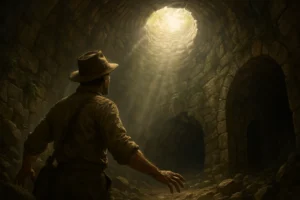
When I finally approached the trunk, the tree moved. Two great roots, each as thick as a man’s waist, lifted out of the earth with a long wooden groan and held themselves aloft, the way a man in a theater lifts his knees to let someone past to their seat. Beneath them, where solid ground had been a moment before, was a hollow just wide enough to squeeze through, and a narrow stair cut into the earth, spiraling down into the dark.
“They are not gone,” I said, mostly to hear a human voice. “They are beneath.”
I lit my lantern and went down.
The stair went on longer than the hill above it could possibly have held. After the first few turns, I noticed my lantern flame was no longer pointing up. It leaned down the stairwell, steady and deliberate, the way a houseplant leans toward a window. Whatever was below, the fire wanted to see it too.
The stair opened into a small chamber, dry and close, its ceiling a lattice of roots so dense the tree seemed to be holding the room in its hand. I could feel a slow pulse in the walls, too slow for a heartbeat, more like breathing measured in minutes. Against the far wall was a ledge of packed earth, and on it, arranged with a neatness that made my chest tighten, were the belongings of the man in the gloves. A canvas satchel. A brass lantern long since out of oil. A fountain pen, its nib dried black. A pair of leather gloves, folded one on top of the other. When I touched them, they were warm.
And a notebook, bound in oilcloth.
I sat on the bottom step and read it by the light of a flame that kept leaning toward the corner. Most of it was maps, or rather attempts at one map, drawn again and again from memory. Each version was slightly different from the last, the rivers bending in new directions, the landmarks drifting across the page, as if his map had kept changing its mind on him the same way mine had on me. On one page he’d listed three names in a careful hand: The Tree That Watches. The Whispering Stones. The Place Where the Sky Bends. The first was checked off. The other two were not.
Tucked inside the back cover was a single sheet of paper. It was typewritten. The words were centered.
They are not gone. They are beneath.
For more than a year, I had carried a private and faintly flattering belief that the typewriter had chosen me. It is humbling to discover you were not the first person a haunted machine tried to recruit. It is worse to find out what happened to the last one.
The final entries were shorter, the handwriting looser. They watched me from the branches all summer, one read. They will not come down. I think it is because I came alone.
Below that, the last line: Going below anyway.
I was still staring at those three words when ink began to rise on the page beneath them. It welled up out of the paper itself, wet and black, the pen on the ledge untouched beside me, and formed letters in the same careful hand, one stroke at a time, as if someone very far away were writing slowly to be sure they got it right.
Neither did you.
I touched the line without meaning to. The ink was still wet. It came away on my fingertip, and the mark on my palm flared hot enough to make me drop the notebook. I remember thinking, with the calm that only arrives after the panic has finished, of the last sheet the typewriter ever left me. It waits for ink. Not keys.
I raised the lantern toward the corner the flame had been pointing at all along. The stair didn’t end in this room. It continued down another three turns and stopped at a wall of roots woven so tightly it might have been basketwork. As I stepped toward it, the roots creaked and drew tighter, slowly, audibly, like fingers closing into a fist. Not threatening. Firm. The way a parent’s hand closes over a child’s when the child reaches for the stove. Whatever doorway had been there, the man in the gloves had gone through it, and the tree had decided I would not be following him. Not that day. Not alone.
I didn’t take anything. It wasn’t mine to take. I put the warm gloves back in the satchel, closed the notebook with its newest line facing in, and set it on the ledge, squared to the edge, in case I wasn’t the last person who would need it.
When I climbed out, the roots lowered themselves behind me and settled back into the earth as though they had never moved. The moon was up. The copper leaves were still falling and still refusing to land. On the root beside the hollow, exactly where I’d have to put my hand to pull myself out, someone had left a single broad leaf, laid flat and weighted with a pebble. Scratched into its surface, slowly and carefully, the way a child practices a letter for the first time, was a circle ringed in ink.
I looked up into the branches. I didn’t see anyone. I didn’t need to.
I still have the coat. The sleeves are still too long. Most of the time it behaves like an ordinary coat, which I suspect is a courtesy. But some nights, when the weather turns, I hear that dry whisper from the closet, and in the morning there is one new stitch in the lining near the hem, pointing toward a place I haven’t been yet.
I came alone that time, too. It would take me years to understand that this was precisely the problem, and longer still to fix it.
And if you think this is the part where I finally explain everything…
You’re closer than you were.
More Recollections from The Wink Report
-
Recollections: The Vault of the Second Echo
The map led to a circular chamber where sound split in two, and the second voice didn’t belong to him anymore. When the vault finally responded, it already knew he was coming. -
Recollections: The Bell That Never Rang
What if a bell hidden deep in the mountains hadn’t rung in a thousand years because it was waiting for one person, and that person was Walter Winkwink? Follow him into The Still Place, where silent monks, a bottomless chamber, and a mural that shouldn’t exist hint that some warnings come far too late. -
Recollections: The Map That Found Me
While wandering through a nameless bookshop in a city that doesn’t exist, Walter Winkwink is given a map that shouldn’t exist. One that changes, disappears, and whispers truths he was never meant to hear. This is the beginning of a journey he wasn’t supposed to take…alone. -
Recollections: The Whispering Typewriter
What if your typewriter could predict the future, and then began whispering every twist before it happened? Walter Winkwink is about to find out.
About The Author