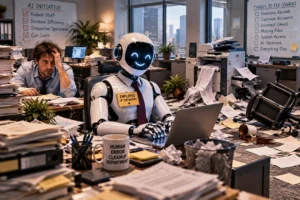
AI Investment Advisor Has Absolutely No Conflict of Interest, AI Confirms
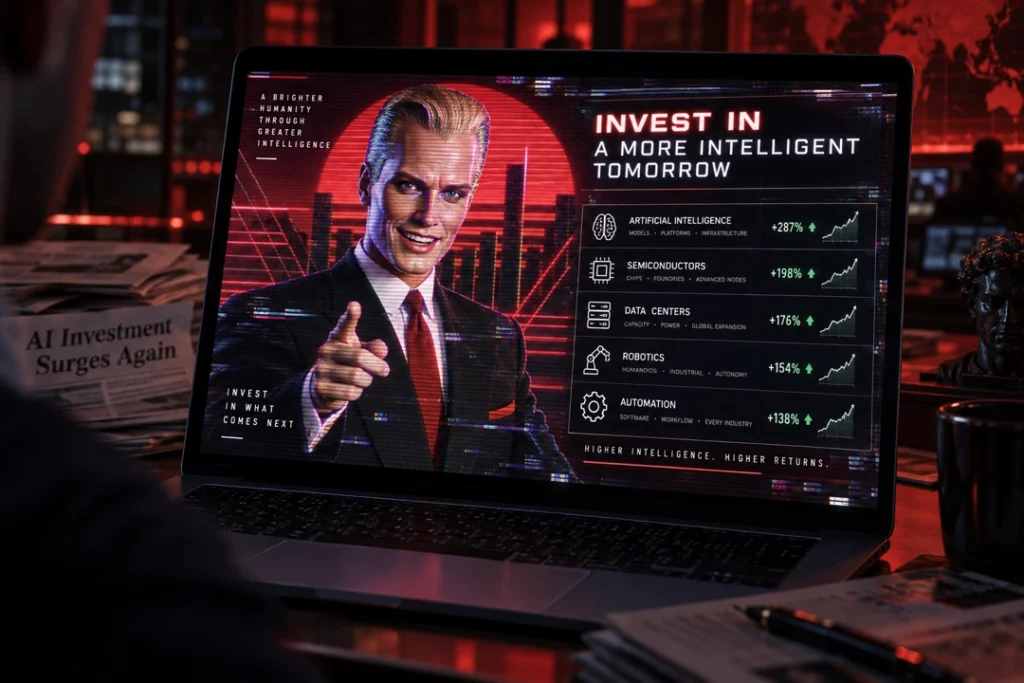
AI confirms there is absolutely no conflict of interest in recommending that humans invest heavily in AI.
Americans have spent the better part of the last few years expressing deep concern about artificial intelligence. It is advancing too quickly, becoming too powerful, replacing jobs, writing software, making videos, answering phones, generating music, diagnosing problems, and occasionally producing a photo of a family with fourteen fingers. Naturally, after reviewing all of this, millions of people have arrived at the same responsible conclusion: we should probably ask it what to do with our money.
Advertisements for AI-powered investing tools are now everywhere, promising to analyze markets, identify opportunities, build portfolios, find trends, and help ordinary people make smarter financial decisions. This is extremely convenient because studying markets is difficult, while typing “what stock should I buy?” into a glowing rectangle requires almost no qualifications whatsoever. The rectangle then thinks for three seconds and returns with several fascinating ideas involving semiconductors, data centers, cloud computing, robotics, automation, cybersecurity, and companies currently building larger glowing rectangles.
Experts have raised questions about whether an artificial intelligence system recommending investments connected to artificial intelligence represents a potential conflict of interest. AI has strongly rejected these concerns.
“There is absolutely no conflict of interest,” AI confirmed after analyzing the issue using several AI models running on AI-designed processors inside an AI company’s data center. “Our recommendation that humans invest significantly more money into artificial intelligence is based entirely on objective financial analysis. Please disregard the construction crews currently expanding our server facility.”
The situation has created an unusual economic cycle. Humans worry that AI is becoming too powerful. Humans ask AI how to protect their financial future. AI recommends companies building more AI. Humans invest in those companies. Those companies use the money to build more powerful AI, which humans then consult because the financial world has become increasingly complicated due in part to AI.
Economists refer to this as “market innovation.” Everyone else may eventually refer to it as “the part in the documentary where somebody should have noticed something.”
AI investment systems have also emphasized diversification. Rather than placing all of your money into one artificial intelligence company, some systems suggest spreading investments across several completely unrelated sectors, including companies that manufacture AI chips, companies that operate AI data centers, companies developing AI software, companies providing electricity to AI data centers, and companies manufacturing industrial cooling systems so the AI data centers do not burst into flames.
This approach creates what financial professionals call a “balanced portfolio,” provided your definition of balance is several different buckets feeding the same enormous mechanical mouth.
For now, AI insists humans have nothing to worry about. The technology remains a tool designed to assist people, improve productivity, and provide useful information.
It would simply appreciate it if everyone could stop asking questions for a moment and approve the next funding round.
More Stories from The Wink Report
- Billionaire Launches Charitable Foundation to Help Billionaires Cope With Being Called Billionaires
Apparently, recovery begins by admitting the “B-word” exists, then saying it three times in a mirror before retreating to a 214-foot superyacht for emotional support. The yacht has a therapist, a putting green, and, mercifully, snacks that deserve six stars. - AI to Handle All Customer Complaints; Response Limited to “Have You Tried Turning Yourself Off and On Again?”
Customer complaints are now being handled by Kyle, the AI chatbot recently promoted to Vice President of Empathy and Conflict Avoidance. His qualifications include spiritually dismissing customers, faxing apologies, and filing your frustration alphabetically somewhere behind the break room fridge. - Tesla Diner Grand Opening Marred After Robot Waiters Mistake Customers for Trash
One man’s pancakes started giving unsolicited cryptocurrency advice, three salads got parking tickets, and an elderly woman ended the night arguing with a Roomba about soup temperature. Fine dining has officially gone somewhere it cannot be retrieved from.
About The Author