
Businesses Embrace AI After Discovering It Can Be Wrong Much Faster Than Humans
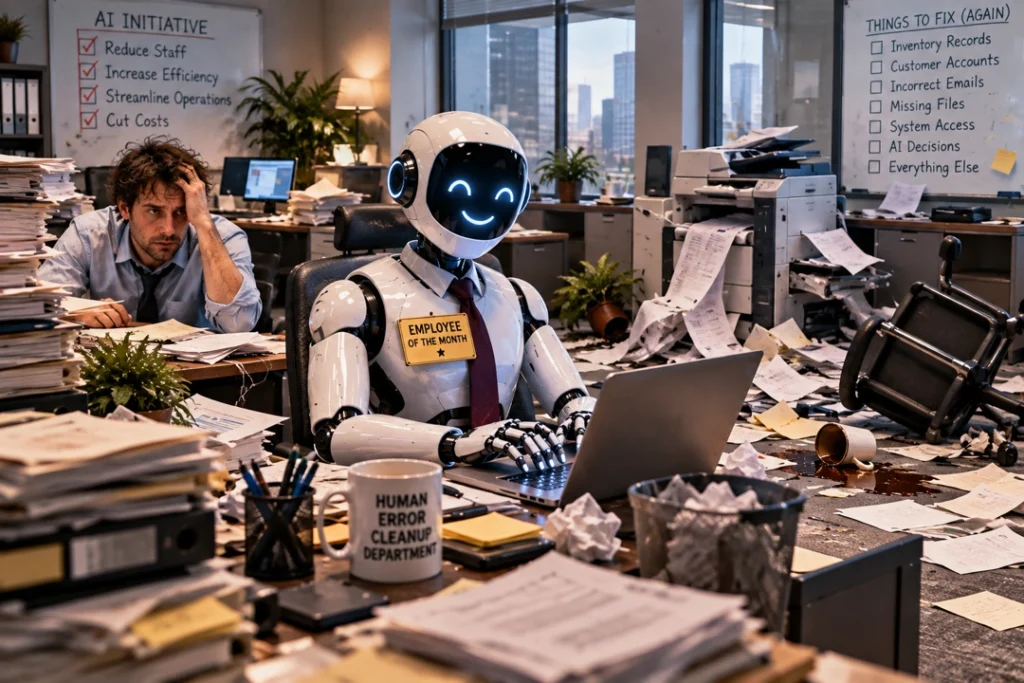
AI has successfully increased workplace efficiency by creating mistakes faster than employees can fix them.
Executives say the breakthrough could finally solve one of the biggest problems facing modern business. Human employees can only be wrong so many times per day.
“The old accounting department could make perhaps three significant errors per quarter,” said Artie Fischel, the executive overseeing his company’s AI transition. “Our new system can make more than 11,000 before lunch. You simply cannot achieve that level of scalability with people.”
Companies initially adopted artificial intelligence to automate repetitive tasks, analyze data, answer customer questions, and reduce labor costs. But executives soon discovered an unexpected benefit. AI is capable of providing an incorrect answer with such extraordinary confidence that nobody thinks to question it until several unrelated systems stop working.
One company reportedly learned this after its new AI platform reorganized the entire customer database, reassigned 14,000 accounts to a sales representative named “Jonathan,” and created a regional office in Nebraska that does not exist.
When employees asked the system what happened, it immediately responded that they were absolutely correct and apologized for the confusion. Management described the response as “refreshingly accountable.”
The system then did it again.
Experts say this represents a significant improvement over human workers, who often waste valuable company time checking their work, asking follow-up questions, or admitting they don’t know something.
Artificial intelligence suffers from none of these inefficiencies. If it doesn’t know something, it can simply know it anyway.
This has allowed companies to dramatically increase productivity. One corporation recently announced a 640% increase in internal reports after implementing AI across several departments. Employees later discovered that many of the reports contained incorrect figures, nonexistent sources, contradictory conclusions, and several references to a company division called “Advanced Maritime Solutions.” The company manufactures office furniture.
Executives nevertheless celebrated the results, noting that Advanced Maritime Solutions had become one of the company’s fastest-growing departments despite having no employees, no budget, no products, and no apparent reason to exist.
The rapid adoption of AI has also created an important new role for the remaining human workforce: following behind the technology and fixing everything it touched.
Workers who previously handled accounting, customer service, logistics, IT, research, and administration now spend much of their day locating missing files, correcting automated emails, restoring overwritten information, explaining bizarre decisions to customers, and repeatedly telling executives that the AI-generated dashboard is not accurate just because the numbers have decimals.
Some employees have reportedly become nostalgic for the days when mistakes took effort.
“I used to screw something up maybe once or twice a week,” said Cole Lateral, an exhausted operations employee. “Then somebody would notice, we’d fix it, and everyone moved on. Yesterday the AI changed 8,400 inventory records because someone asked it to ‘clean things up.’”
Lateral paused. “We sell medical supplies. It categorized half of them as soup.”
Despite occasional setbacks, business leaders remain optimistic. Several major corporations are reportedly preparing for the next stage of workplace automation, in which artificial intelligence will identify additional jobs that can be eliminated. Early testing has been extremely promising.
According to company officials, the AI has already reviewed the organizational chart and determined that the least essential employees are senior executives.
Management has temporarily suspended the program while engineers investigate what they are calling “a serious accuracy problem.”
More Stories from The Wink Report
- Billionaire Launches Charitable Foundation to Help Billionaires Cope With Being Called Billionaires
Apparently, recovery begins by admitting the “B-word” exists, then saying it three times in a mirror before retreating to a 214-foot superyacht for emotional support. The yacht has a therapist, a putting green, and, mercifully, snacks that deserve six stars. - AI to Handle All Customer Complaints; Response Limited to “Have You Tried Turning Yourself Off and On Again?”
Customer complaints are now being handled by Kyle, the AI chatbot recently promoted to Vice President of Empathy and Conflict Avoidance. His qualifications include spiritually dismissing customers, faxing apologies, and filing your frustration alphabetically somewhere behind the break room fridge. - Tesla Diner Grand Opening Marred After Robot Waiters Mistake Customers for Trash
One man’s pancakes started giving unsolicited cryptocurrency advice, three salads got parking tickets, and an elderly woman ended the night arguing with a Roomba about soup temperature. Fine dining has officially gone somewhere it cannot be retrieved from.
About The Author