How to Fart at Work: A Professional Guide to Passing Gas Without Destroying Your Career
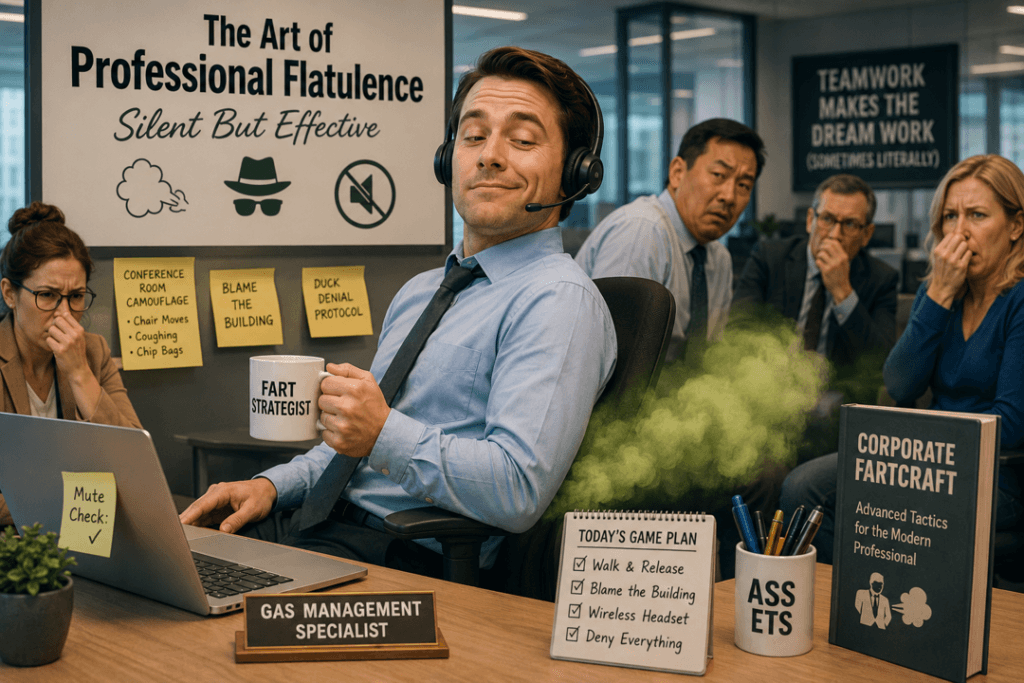
A trained professional demonstrates advanced workplace gas management while coworkers reconsider their career choices.
For decades, workplace experts have written thousands of books about leadership, communication, productivity, conflict resolution, time management, and how to shake someone’s hand without looking like you’re trying to steal their wristwatch. Yet almost nobody has addressed one of the most common situations faced by the American worker: You have to fart.
This is particularly troubling because passing gas at work is considerably more complicated than doing it anywhere else. At home, you can simply release whatever your body has prepared and allow your family to deal with the consequences. At work, however, there are coworkers, supervisors, conference rooms, elevators, cubicles, customers, and occasionally an innocent UPS driver who has wandered into a situation he does not deserve.
Fortunately, The Wink Report has developed the following professional guidelines for managing an unexpected intestinal communiqué without permanently damaging your career.
Strategy One: The Walk-and-Release
Never deploy a trouser cough while stationary if you can avoid it. Remaining in one location establishes what investigators call a “point of origin.” Instead, begin walking at a normal pace and gradually release the situation across a much larger geographical area.
This distributes the evidence.
The experienced practitioner can spread one atmospheric discharge across Accounting, Human Resources, and approximately fourteen feet of hallway, making identification nearly impossible. If someone detects it, you are already somewhere near the copier asking Janet whether she has seen the quarterly numbers.
This is not running away. It is gas diversification, and frankly, more companies should include it in their risk-management strategies.
Strategy Two: The Conference Room Gamble
Meetings are dangerous because everyone is trapped. If you absolutely must sound the butt trumpet during a meeting, wait until someone begins moving furniture, coughing, opening a bag of chips, or passionately explaining something nobody cares about. These noises provide excellent acoustic camouflage.
However, understand that sound is only half the problem. A silent cheek squeak in a conference room can actually be worse because it creates what workplace scientists call The Suspicion Window.
This begins approximately four seconds after release.
Someone’s nose twitches. Another employee looks up. Nobody says anything. Then Greg slowly looks around the table.
Do not look around with him.
The guilty party who immediately begins searching for the guilty party has made a catastrophic tactical mistake. Continue staring at your spreadsheet as though nothing unusual has happened. If necessary, look mildly disappointed in someone else.
Strategy Three: Blame the Building
Office buildings contain thousands of mysterious smells. This is one of their greatest benefits. If someone says, “What is that smell?” never say, “I don’t smell anything.” That is the response of a criminal.
Instead, sniff thoughtfully and say something like, “Yeah, I’ve noticed that too. I think it’s the vents.” You have now transformed your gastrointestinal announcement into a facilities-management issue.
With sufficient confidence, someone may eventually submit a maintenance ticket. At that point, your fart has officially entered the corporate bureaucracy and is no longer your responsibility. If a maintenance technician eventually arrives and begins inspecting the HVAC system, remain silent. That man is now being paid to investigate your ass.
Let him work.
Strategy Four: The Home-Office Advantage
Working from home has revolutionized professional flatulence. For the first time in human history, millions of employees can participate in important meetings while unleashing absolutely catastrophic under-desk weather events with virtually no professional consequences.
The mute button deserves considerable credit, but the true hero of remote workplace gas management is the wireless headset.
Wireless headsets are a godsend.
If you feel a significant pressure-management event approaching during a meeting, simply mute yourself, stand up, and casually walk away from your immediate desk area. Do not release directly into your chair. This is your workspace. You still have to sit there afterward.
Instead, establish a secondary location.
A hallway works. The laundry room works. The kitchen can work, although food-preparation areas should generally be avoided during Category 4 events. Advanced remote employees may even identify a permanent Designated Blast Zone somewhere in the house.
The wireless headset allows you to remain fully engaged in the meeting while transporting the problem to a safer location. You can listen to Karen explain the quarterly forecast while standing seventeen feet away from your computer, silently releasing a forbidden exhale into an unoccupied hallway.
This is technology improving lives.
But beware: always verify that you are actually muted.
There are few moments more professionally devastating than confidently stepping away from your desk during a quarterly Zoom meeting, lifting one leg slightly, releasing something that sounds like a Harley-Davidson attempting to start underwater, and then hearing twelve coworkers suddenly stop talking through your headset.
If this happens, do not panic. Simply say, “Sorry, there’s construction outside.” Then immediately mute yourself before anyone asks what construction company is using heavy machinery under your desk.
Strategy Five: Never Fart in an Elevator
This should not require explanation.
An elevator is a small metal box containing witnesses. There is nowhere to flee, no meaningful ventilation strategy, and no plausible explanation involving the HVAC system when everyone watched you enter the elevator six seconds before the atmosphere became hostile to human life.
If you accidentally release a lower-deck foghorn immediately before exiting the elevator, however, congratulations. You have executed one of the darkest maneuvers available to the modern office worker: The Elevator Bomb.
The doors close. You walk away. The next group enters.
You are now legally required to keep walking. Never turn around. Never acknowledge what you’ve done. Never return to that floor.
The Bathroom Is Not Always the Answer
People frequently suggest simply going to the bathroom whenever you need to release a rear-end press release. These people have apparently never experienced one that arrives with seventeen milliseconds of warning.
Sometimes, however, you do make it to the restroom. This is generally the safest possible outcome because bathrooms are internationally recognized as neutral territory for gastrointestinal warfare.
There is one complication: someone else may already be in there.
Perhaps you are in Stall Three when your digestive system produces something so violent that the gentleman in Stall Two stops scrolling on his phone. The sound echoes off the tile. The room becomes silent. There is no question about what just happened or where it came from.
You have one remaining option. Wait approximately two seconds and say:
“Did you just see that duck run through here?!?”
This accomplishes several things simultaneously. First, it acknowledges the noise without accepting responsibility. Second, it introduces the possibility of an escaped waterfowl roaming beneath the stall doors. Third, it forces the other person to decide whether correcting you is worth having a conversation with a stranger who apparently believes a duck just sprinted through a corporate restroom.
If necessary, continue the deception. “Swear to God. Little bastard ran right under my stall.”
Do not overdo it. You are not required to provide a species, description, or estimated wingspan. Your objective is merely to introduce reasonable doubt.
Was it a fart? Was it a duck? Nobody can prove anything.
Know When You’ve Lost
Occasionally, despite your training, everything will go wrong.
You miscalculated. The colon cannon was louder than expected. There was no coughing. Nobody moved a chair. The air conditioning stopped at precisely the wrong moment. Everyone heard it.
At this point, denial is useless. You have two options.
Option one is to quietly say, “Excuse me,” and continue working like a functioning adult. Option two is to stare directly at the person sitting next to you and whisper, “Jesus, Kevin.”
The Wink Report cannot officially recommend Option Two.
But Walter can.
More Stories from The Wink Report
- If the Wine Doesn’t Get You, the Jalapeño Yogurt Will: Costco’s Conspiracy Deepens
Somewhere between sipping wine samples and accidentally making eye contact with a tub labeled “jalapeño yogurt,” shoppers reportedly realized Costco’s master plan isn’t bulk savings. It’s emotional whiplash, where one bite feels like a dare and the next like a legally binding mistake. - Satirist Hospitalized After Attempting to Read the News Without Screaming
Doctors reportedly diagnosed the patient with “acute reality exposure” and a severe irony deficiency after just three headlines, confirming that reading the news raw is now considered a high-risk activity requiring protective satire equipment. - Skyline Chili Flavored Ice Cream Accidentally Summons 3rd Portal to Hell; Satan Confused but Intrigued
Somewhere between the oyster crackers and the “this actually tastes like cinnamon and nutmeg, not regret” realization, humanity briefly paused to ask if we’d gone too far, right before accidentally opening a portal and politely offering it a spoon.
About The Author